Key Takeaways
Task Paralysis Is Neurological, Not Moral: Struggling to start an email, pay a bill, or organise a room is rarely a character flaw; it is frequently the result of executive function friction and autonomic nervous system overload.
The Hidden Cost of High-Masking: Many high-achieving adults camouflage unrecognised ADHD traits behind perfectionism, over-preparation, and people-pleasing - an exhausting performance that leads directly to nervous system burnout.
Rejection Sensitivity & Toxic Shame: Years of subtle criticism for missed details or forgotten tasks create acute Rejection Sensitivity Dysphoria (RSD) and deep-seated toxic shame (Beaton et al., 2020; DeYoung, 2015).
Restoring Agency Over Compliance: Effective therapy does not force neurodivergent minds into rigid neurotypical moulds; it lowers shame, builds bespoke external scaffolding, and allows you to drop the protective mask (Jones, 2026).
The Frozen Screen: When Maximum Effort Looks Like Inaction
Imagine sitting at your desk staring at a routine, five-minute email you desperately need to send. Your chest feels tight, your mind is racing through twenty competing thoughts, and an hour slips by without a single word typed. From the outside, it looks as though you are doing nothing. Inside, you are berating yourself: Why am I so lazy? Why can’t I just get on with it like everyone else?
To understand what is actually happening in that moment, picture a computer with forty-seven heavy programmes running silently in the background.
To someone glancing at the monitor, the cursor is frozen and the machine appears idle. Beneath the casing, however, the processor is overheating at 100 per cent capacity simply trying not to crash.
For many adults living with unrecognised or late-identified ADHD, daily life feels remarkably similar. What observers—and eventually the individual themselves - label as "laziness," "procrastination," or "lack of discipline" is often autonomic overload.
Executive Function vs. Moral Character
Traditional mental health frameworks have historically viewed attention and organisational struggles through a deficit-based lens, implying that an individual simply needs to try harder, buy a better planner, or exercise greater willpower.
In ADHD-Informed Therapy, Brian Jones challenges this pathologising narrative, reframing ADHD not as a moral or cognitive defect, but as a distinct neurodevelopmental profile characterised by differences in executive function, dopamine regulation, and emotional processing (Jones, 2026; Ginapp et al., 2023).
Executive functions act as the brain’s air-traffic control system - managing task initiation, working memory, time perception, and attentional shifting. When that system hits an invisible wall of friction, the nervous system does not calmly wait; it registers threat. Rapidly, the body flips into hyper-arousal (panicked over-thinking, agitation, chest tightness) or collapses into hypo-arousal (mental fog, emotional numbness, scrolling on a phone to escape the distress).
Research by Beaton, Sirois, and Milne (2020, 2022) demonstrates that adults with ADHD traits experience significantly higher levels of perceived criticism throughout their lives than their neurotypical peers. Over time, repeated external reprimands - "You're so careless," "You're not reaching your potential," "Why did you leave this until the last minute?" - are internalised. Executive friction stops being something you experience and becomes a verdict on who you are.
The Exhausting Price of Masking and Rejection Sensitivity
To survive in workplaces and relationships built around neurotypical expectations, many intelligent adults develop sophisticated masking strategies. Outwardly, they may appear highly competent, reliable, and composed. Privately, that competence is purchased at an unsustainable autonomic cost:
Working twice as late as colleagues to compensate for daytime distractibility.
Over-preparing and rehearsing conversations to avoid making a visible mistake.
Relying on last-minute adrenaline and panic to force task initiation.
Apologising excessively and people-pleasing to pre-empt disapproval.
Beneath this protective armour often sits Rejection Sensitivity Dysphoria (RSD)—an intense, sudden surge of emotional pain triggered by perceived criticism, a brief tone in a text message, or the fear of letting someone down (Rowney-Smith et al., 2026).
Through the lens of Patricia DeYoung’s relational work on chronic shame (DeYoung, 2015) and Leigh McCullough’s Triangle of Conflict (McCullough et al., 2003), we can see how masking and avoidance operate as intelligent survival defences:
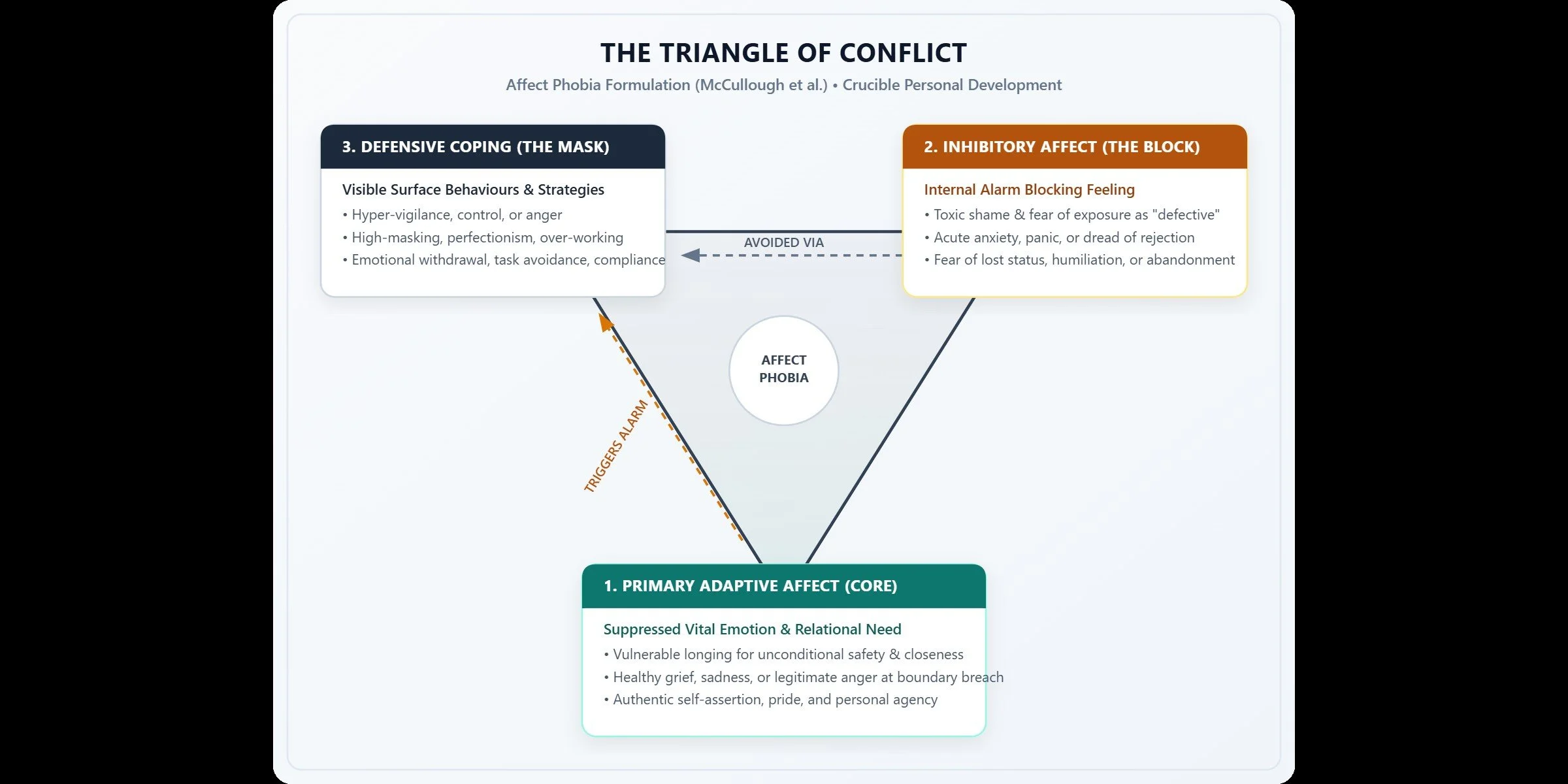
When every unfinished task carries the emotional weight of potential humiliation, avoiding the task is not laziness - it is an autonomic attempt to shield yourself from another hit of shame.
Moving From Compliance to Agency
Forcing an overwhelmed nervous system to comply through harsh self-criticism only pours fuel on the fire. Shame activates the body's threat response, which further impairs the prefrontal cortex - making executive task initiation even harder.
At Crucible Personal Development, we take a relational, de-pathologising approach to working with executive overload, masking, and chronic shame. Rather than handing out rigid productivity rules that set you up to fail, we work collaboratively to restore your personal agency:
Separating Wiring from Identity: We unpick years of internalised self-blame, recognising where your nervous system has been working overtime to mask executive differences.
Co-Creating Frictionless Scaffolding: Moving away from neurotypical "shoulds," we design bespoke, external structures—such as micro-stepping, visual anchors, and dopamine-friendly routines - that work with your neurology rather than against it.
Expanding Affect Tolerance: Working safely within your Window of Tolerance, we build your capacity to notice spikes of Rejection Sensitivity or overwhelm in real time, grounding the body before panic or shutdown takes over.
Dropping the Mask in Safety: Perhaps most importantly, therapy offers an active, engaged, and non-judgmental relationship where you do not have to perform competence - allowing you to lay down the exhausting armour and reclaim genuine energy.
Reclaiming Your Energy
If you have spent years feeling as though you are running a marathon while appearing to stand still, you do not need more self-criticism. Understanding how your nervous system responds to executive overload and relational threat is the first step toward stepping out of the shame cycle and building a way of living and working that genuinely fits you.
Crucible Personal Development is a private psychotherapy and counselling practice in Preston, Lancashire.
References
Beaton, D. M., Sirois, F., & Milne, E. (2020). Self-compassion and perceived criticism in adults with attention deficit hyperactivity disorder (ADHD). Mindfulness, 11(11), 2506–2518.
Beaton, D. M., Sirois, F., & Milne, E. (2022). Experiences of criticism in adults with ADHD: A qualitative study. PLOS ONE, 17(2), e0263366.
DeYoung, P. A. (2015). Understanding and Treating Chronic Shame: A Relational/Neurobiological Approach. Routledge.
Ginapp, C. M., Greenberg, N. R., MacDonald-Gagnon, G., Angarita, G. A., Bold, K. W., & Potenza, M. N. (2023). "Dysregulated not deficit": A qualitative study on symptomatology of ADHD in young adults. PLOS ONE, 18(10), e0292721.
Jones, B. (2026). ADHD-Informed Therapy: A Practical Guide to Supporting Adults with ADHD.
McCullough, L., Kuhn, N., Andrews, S., Cabaniss, A., Goodman, A., & Hurley, C. (2003). Treating Affect Phobia: A Manual for Short-Term Dynamic Psychotherapy. Guilford Press.
Rowney-Smith, A., Sutton, B., Quadt, L., & Eccles, J. A. (2026). The lived experience of rejection sensitivity in ADHD – A qualitative exploration. PLOS ONE, 21(1), e0314669.